This approach goes beyond simple data aggregation by connecting and semantically analyzing knowledge and data across multiple domains, enabling organizations to use their data assets in a more strategic and integrated way.
S2W’s Multi-Domain Cross-Analysis technology links domain-specific ontologies and knowledge graphs to uncover hidden insights across complex datasets.
Problem
Definition
Defining
Objective
Data Definition
& Analysis
Ontology
Design
Knowledge
Graph
Construction
User Validation
& Feedback
1. Problem Definition
At this stage, S2W determines which concepts are critical within the target domain and how they relate to one another. Based on this understanding, we design the initial structure of the ontology, which serves as a foundation for subsequent data analysis and knowledge graph construction.
2. Defining Objective
Through this step, technical indicators such as precision, processing speed, scalability, and applicability are set. It also clarifies what results can be achieved by leveraging the defined ontology structure and data (e.g., insight analysis, security monitoring systems, domain-specific generative AI based on internal data).
Because analytical objectives are often not singular, it is important to outline multiple potential scenarios and use cases. Doing so ensures a flexible foundation that can be expanded and refined in subsequent stages.
3. Data Definition & Analysis
We then establish a pipeline to automatically detect and classify entities
within the data,standardizing their representation and meaning to ensure
machine-readable semantic understanding.
Within each domain, we identify core entities and analyze their
relationships.By interpreting both the definitions of nodes and their
contextual relationships,we lay the foundation for a structured, context-
aware ontology and knowledge graph.
4. Ontology Design
At this stage, the previously extracted entities and relationships are
modeled to reflect how each concept is semantically connected.
Relationships can be unidirectional or bidirectional, hierarchical or network-
based, and are informed by both domain expertise and data analysis.
The ontology functions as a schema for building the knowledge graph and
forms the foundation for semantic reasoning and advanced analysis.
5. Knowledge Graph Construction
In a domain-specific knowledge graph, both internal and external datasets
are mapped to the ontology framework and represented as nodes and
edges. Knowledge elements extracted from multiple domains are
semantically connected within a unified network, enabling advanced
analysis such as relationship inference and similarity detection.
6. User Validation & Feedback
Based on validation results, the process returns to earlier stages such as
problem definition and goal setting. Through this iterative enhancement, the
ontology and knowledge graph are continuously refined and expanded,
enabling organizations and users to manage and operate data more
effectively and efficiently.
In this stage, the independently built knowledge structures of each domain are compared and analyzed to identify shared concepts, semantic similarities, and contextual connections. By examining not only the definition of each node but also its surrounding relationships and attributes, hidden semantic links can be uncovered between entities that appear logically or physically disconnected.
Through this cross-domain analysis, organizations gain the ability to reveal latent relationships across domains, reinterpret complex challenges from a unified perspective, and derive deeper insights and more precise decision-making in intricate data environments.
SAIP transforms expert knowledge into a domain-specific ontology and connected knowledge graph, capturing real-world concepts and rules to deliver consistent, context-aware decisions across the organization.
DetailsQUAXAR is a comprehensive Cyber Threat Intelligence (CTI) Platform that integrates Digital Risk Protection (DRP), Threat Intelligence (TI), and Attack Surface Management (ASM) solutions into a single, unified system. This robust platform empowers businesses to safeguard their critical internal assets and proactively address potential threats with immediately actionable intelligence.
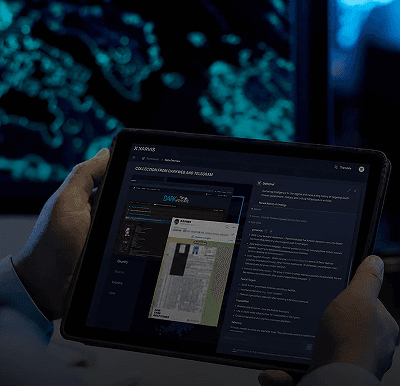
DetailsXARVIS is an AI-based Cybercrime Intelligence Platform that leverages big data from covert channels such as the Dark Web and Telegram, which are rife with cybercrime, to provide crucial intelligence essential for national security and public safety.
Furthermore, XARVIS utilizes a diverse array of intelligence sources, including virtual currency tracking and identifiers like Telegram/email IDs and PGP Keys, to meticulously trace the activities of threat actors. The platform further enhances its interactive and analytical AI capabilities with a feature called DarkCHAT, which offers functionalities comparable to ChatGPT.
EYEZ is a Virtual Asset Intelligence Solution that combines ledger tracking technology on large-scale blockchain transaction data with security threat information. This includes reputation information from the Dark Web and social channels, as well as sanction information from public institutions. It enables users to analyze the association and flow of various security threats and related illegal virtual assets.
Details
Our team will review your inquiry and
contact you promptly. Thank you.
Our team will review your application and
contact you promptly. Thank you.